


Welcome to the best BG3 Swarmkeeper Build. For this build, we will be using the Swarmkeeper subclass of Ranger, which allows you to call on swarms of small creatures to damage and disrupt enemies. At higher levels, you can use the swarms to teleport your character.
The Ranger excels at using ranged weapons to deal high damage to enemies before they can get close, and also has some fairly limited Spellcasting abilities.
For more Ranger builds, visit our BG3 Ranger Builds page or explore the complete BG3 Builds Database. We also have an optimized BG3 Minsc Build (Ranger). You can also check out our BG3 Builds Tier List to see which builds perform best.
Table of Contents:
- Swarmkeeper Build Overview
- Character Creation
- Swarmkeeper Build Levelling Progression
- Swarmkeeper Equipment
- Swarmkeeper Build Extra Info
Before we get started, a quick look at the Strengths and Weaknesses of the Swarmkeeper Ranger in Baldur’s Gate 3:
Swarmkeeper Strengths
Swarmkeeper Weaknesses

BG3 Swarmkeeper Build Overview
We’ll start with a basic overview of the Ranger class and the Swarmkeeper subclass, which we’ll be using for this build. If you’re already familiar with how they work, please skip this section.
Ranger Class Summary
Here are the most important features of the Ranger class in Baldur’s Gate 3:
 Bounty Hunter (Level 1) – You gain Investigation Proficiency. Creatures you hit with Ensnaring Strike have
  Disadvantage on their Saving Throw.
- Archery Fighting Style (Level 2) – You gain a +2 bonus to ranged weapon
 Attack Rolls
 - Extra Attack (Level 5) – Each Action yields two weapon attacks, rather than one.
- Land’s Stride: Difficult Terrain (Level 8) – Difficult Terrain no longer slows you down
- Hide in Plain Sight (Level 10) – Gain a +10 bonus to Stealth Checks, as long as you are standing still.
 Disadvantage on their
  Saving Throw.
 Attack Rolls
BG3 Swarmkeeper Summary
Here are the most important aspects of the Swarmkeeper subclass in BG3:
- Gathered Swarm (Level 3) – Choose a swarm of nature spirits to form a bond with. The swarm can take an action once per combat round. In addition to the effects mentioned below, all swarms can be used to teleport your Swarmkeeper by up to 5 metres.
- Cloud of Jellyfish – Deals Lightning Damage and can Shock enemies, preventing them from taking Reactions.
- Flurry of Moths – Deals Psychic Damage. Can Blind targets.
- Legion of Bees – Deals Piercing Damage. Can push a target back by up to 5 metres.
- Writhing Tide (Level 7) – Your swarm carries you into the air. You can fly at a speed of 9m per turn.
- Mighty Swarm (Level 11) – Your Swarms deal more damage. Teleporting with your Swarm now gives you +2 Armour Class until the end of your turn. Each Swarm special attack now has an additional feature:
- Jellyfish can now Shock and Disarm a target.
- Moths can now Blind and Slow a target.
- Bees can now knock a target back and knock them Prone.
- Jellyfish can now
 Cloud of Jellyfish – Deals
 Shock enemies, preventing them from taking
  Reactions.
 Flurry of Moths – Deals
 Blind targets.
 Legion of Bees – Deals
 Mighty Swarm (Level 11) – Your Swarms deal more damage. Teleporting with your Swarm now gives you +2
  Armour Class until the end of your turn. Each Swarm special attack now has an additional feature:
 Disarm a target.
 Slow a target.
 Prone.
The great thing about the Swarm actions is that they are separate from your character’s action resources. This means that you don’t need to spend an Action, Bonus Action or Reaction to activate them.
If you don’t know what we mean by terms like Advantage, Proficiency or Saving Throw, or want to find out how systems like Stealth work, you will find our BG3 Hidden Mechanics Guide very useful.
Character Creation (Level 1) for the BG3 Swarmkeeper Build

In this section, we will go over the basic Character Creation options for your Baldur’s Gate 3 Swarmkeeper build, namely Background, Race, Skills and Abilities.
Race
While this build works fine with any race in BG3, some choices have a slight edge because their features synergise with this build.
Here are our top 5 race picks for the Swarmkeeper Build:
| Race | Strengths | Info |
|---|---|---|

Wood Elf |
|
Wood Elves are a great choice for most build types in BG3, thanks to their superior movement speed. Natural Proficiency in Perception is always useful, and immunity to magical Sleep will help you out a lot, especially in the early game, where enemy mages love to spam this spell.
They are especially good for a Ranger, because their extra Movement Speed makes it easier to maintain distance to enemies. |

Githyanki |
|
Githyanki have excellent mobility thanks to Enhance Leap and Misty Step, allowing you to evade melee attackers and stay at range, where the Ranger is strongest.
Additionally, Githyanki get the full benefits from equipping various Githyanki weapons, sometimes granting additional Psychic Damage or special features. |

Drow |
|
The Drow shares many features with the Wood Elf, but does not get the extra Movement Speed.
Drow do get Superior Darkvision, however. This means you’ll never have trouble hitting enemies in dark areas. |

Duergar |
|
With their wide choice of armour and weapon proficiencies, and resistances to poison, charm, and paralysis, Duergar are one of the strongest races in BG3.
The only downside of Duergar is their small stature – this reduces their base Movement Speed to 7.5 metres per turn (most races get 9 metres). |
|
Zariel Tiefling |
|
The Zarial Tiefling’s Darkvision helps them to shoot enemies in dark areas, and the innate Fire Resistance will often be useful, since Fire is one of the more common damage types in BG3.
The Branding Smite spell, unlocked at Level 5, can be used on Ranged Attacks. Therefore, it works surprisingly well with the Ranger. |
 Perception
 Shortswords
 Longswords
 Shortbows
 Longbows
 Fey Ancestry
 Advantage against
  Charmed
 Magical Sleep
 Darkvision
 Fleet of Foot
 Light Armour &
  Medium Armour
 Greatswords
 Astral Knowledge
 Enhance Leap
 Superior Darkvision
 Drow Magic
 Dancing Lights
 Faerie Fire
 Darkness
 Dwarven Resilience
 Poisoned
 Duergar Resilience
 Paralysed
 Enlarge
 Invisibility


Background & Skills
You must choose a Background for your Swarmkeeper build. The Swarmkeeper is best built with high Dexterity and Wisdom, so we’ll aim to get Proficiency with Skills that align with those priorities. Backgrounds provide your character with Skill Proficiency in two predefined Skills.
I recommend choosing the Entertainer Background, which gives the following Skill Proficiencies:
- Acrobatics (DEX) – Helps your character to resist being pushed by enemies. This is very useful because the AI will always try to push your party members off high ledges whenever it gets a chance. Increasing the Acrobatics Skill reduces the chance of this happening. This Skill is the only reason why we chose the Entertainer.
- For Humans: If you chose the Human Race, you get one unrestricted Skill choice. In that case, you should spend that Skill choice on Acrobatics and choose the Urchin Background.
- Performance (CHA) – Occasionally used in dialogue dice rolls to impress or distract certain characters. This Skill isn’t well-suited to our Ability Distribution, but it comes with the Entertainer Background.
 Acrobatics (DEX) – Helps your character to resist being pushed by enemies. This is very useful because the AI will always try to push your party members off high ledges whenever it gets a chance. Increasing the Acrobatics Skill reduces the chance of this happening. This Skill is the only reason why we chose the Entertainer.
 Performance (CHA) – Occasionally used in dialogue dice rolls to impress or distract certain characters. This Skill isn’t well-suited to our Ability Distribution, but it comes with the Entertainer Background.
After choosing your Background, you can manually select another two Skills from a limited choice of Ranger Skills. We recommend choosing:
- Perception (WIS) – Helps you to spot ambushes and other hidden details in the world.
- Survival (WIS) – Increases your chance to spot buried treasure and supplies while exploring.
 Survival (WIS) – Increases your chance to spot buried treasure and supplies while exploring.
Abilities
We also need to allocate your Swarmkeeper Ranger’s starting abilities. These impact performance in combat situations, and will also impact some Ability and Skill rolls outside combat. For Rangers, the following stats are most important:
- Dexterity – Will determine how good we are at attacking with our ranged weapon
- Wisdom – Determines how good we are at Spellcasting
- Constitution – Dictates our Hitpoints and how likely we are to succeed at Concentration checks (if the effects of a Concentration Spell we cast will be retained when we take damage)
As such, we recommend pushing DEX and WIS as high as possible, and making sure CON is at least 14.
We recommend using the following ability distribution:
- 10 Strength
- 16 Dexterity
- 14 Constitution
- 8 Intelligence
- 16 Wisdom
- 10 Charisma
 10 Strength
 16 Dexterity
 14 Constitution
 8 Intelligence
 16 Wisdom
 10 Charisma
Bolded Abilities are essential for the build. The others can be tweaked if needed.
Favoured Enemy and Natural Explorer
At Level 1, you’ll need to select two Ranger-specific options in the Class menu. These are Favoured Enemy and Natural Explorer.
For  Favoured Enemy, we recommend going with
  Bounty Hunter. This doesn’t immediately do anything useful for us, but it will come in handy later on after we’ve developed our spellcasting options.
For  Natural Explorer, you should choose can choose one of two options:
- Urban Tracker – Gives Sleight of Hand proficiency. Only use this if you want to use your Ranger for Lockpicking or Pickpocketing.
- Wasteland Wanderer: Poison – Gives you Resistance to Poison Damage. This is a very common damage type used by enemies in BG3, so you should grab this if you don’t want the Sleight of Hand Proficiency.
 Urban Tracker
 Sleight of Hand proficiency. Only use this if you want to use your Ranger for Lockpicking or Pickpocketing.
Swarmkeeper Build Full Levelling Guide
We will now walk you through the levelling up process for this Baldur’s Gate 3 Swarmkeeper Build.
Early-Game (2-4) Levelling Progression for the BG3 Swarmkeeper Build
We’ll start with the early-game levels.
Level 2 – Fighting Style & Spells
When you reach Level 2 with your BG3 Swarmkeeper Build, you’ll need to select a Fighting Style and choose 2 Spells to learn.
Your Fighting Style lets you become especially skilled with a particular type of weapon. For this Swarmkeeper Build, we are using the  Archery Fighting Style. This is very important, as it will give you an extra +2 to our Ranged Attack Rolls, making your shots more accurate.
As for Spells, the following two are the best options at this stage, so we recommend choosing them:
- Ensnaring Strike – This is a Concentration spell that lasts for up to 10 turns. While active, your weapon attacks will summon vines that deal extra Piercing Damage and potentially ensnare your target. This is great for pinning down dangerous enemies, and it also synergises with the Bounty Hunter option we chose earlier, causing enemies hit by the spell to have Disadvantage on their Saving Throw.
- Hunter’s Mark – Mark an enemy, causing your attacks to deal extra damage to them. If the target dies before the spell ends, you can reapply Hunter’s Mark to a new creature without spending another Spell Slot.
 Hunter’s Mark
At this stage, we only have two Level one Spell Slots, meaning we can cast just two spells per Long Rest. This is quite limiting for the time being, but you’ll unlock more as you level up further.
Level 3 – Subclass and Spell – BG3 Swarmkeeper Build PC/PS5
At Level 3, we immediately gain an extra Spell Slot, so we can now cast 3 spells before needing to have a Long Rest.
We can now choose an extra spell for the Swarmkeeper build. If you feel like your party needs some extra healing ability, then choose  Cure Wounds, a solid healing spell that can help you out in a pinch. Otherwise, go with
  Speak with Animals (the latter does not consume a Spell Slot if cast outside combat).
This is also the point where you get to choose your subclass. For this build, we’ll be using the Swarmkeeper subclass.
Your Swarmkeeper subclass gives you the following bonuses at Level 3:
- Prey’s Scent – Your swarms deal extra damage to enemies afflicted by Hunter’s Mark.
- Gathered Swarm – Choose one Swarm type that your character will use. You can change the Swarm at each level up, in case you don’t like what you picked.
- Legion of Bees – Can deal Piercing Damage, push enemies away, or teleport you.
- Cloud of Jellyfish – Can deal Lightning Damage, Shock enemies, or teleport you.
- Flurry of Moths – Can deal Psychic Damage, Blind enemies, or teleport you.
-
- Spell Unlocks (Always Prepared)
- Mage Hand – A “handy” Cantrip that allows you to interact with distant objects.
- Faerie Fire – Target an area. All creatures and objects within are forced to be visible, and any Attack Rolls against them have
 Advantage. Creatures can attempt a Saving Throw to resist the effect. This is great for making enemies easier to hit, especially in the early game.


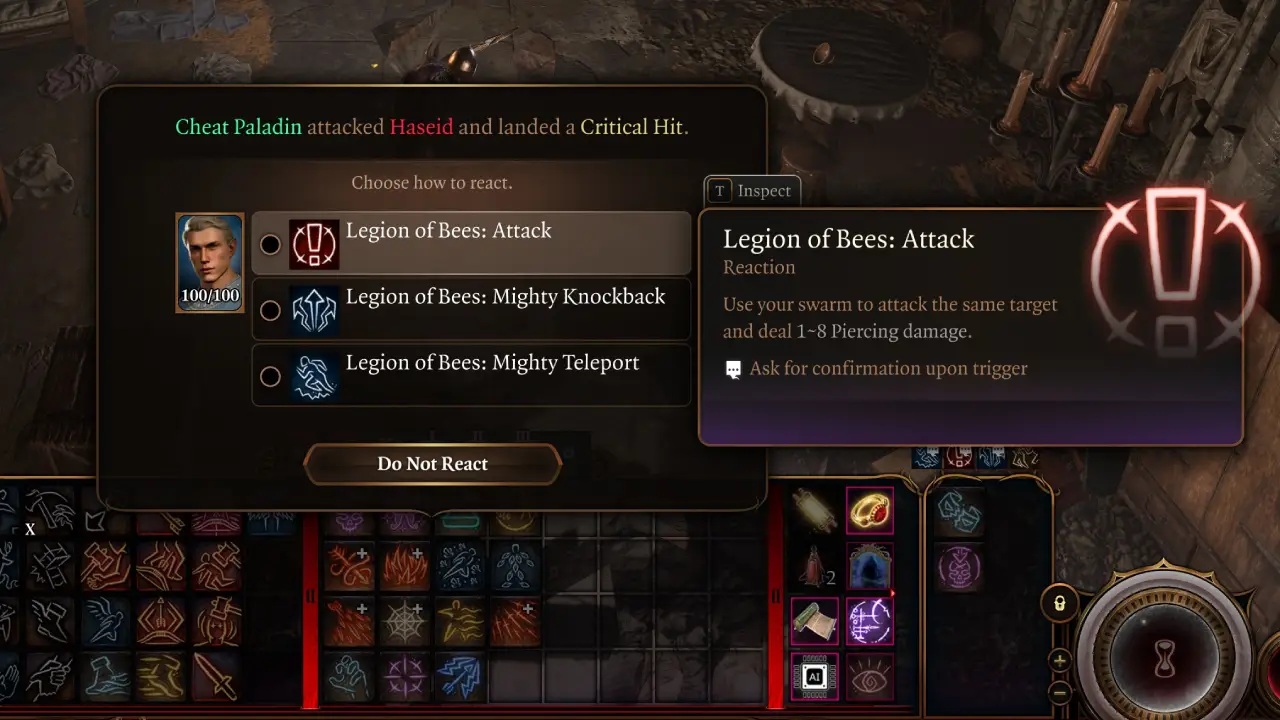
All three of the swarms are pretty good. I prefer to use the Legion of Bees because it helps to keep your Ranger out of melee by pushing enemies away when needed, but you can use one of the others if you prefer. The handy thing about the Swarms is that their “actions” don’t consume an Action, Bonus Action or Reaction. When you hit an opponent with a ranged attack, your swarm will prompt you asking if you want to activate the bonus damage or activate another swarm effect. This can only happen once per turn.
Level 4 – Feat
At Level 4, we’ll need to choose a Feat for our Ranger Swarmkeeper Build. Feats are strong passive buffs for your character that can help to define your build. Choose Ability Improvement, which gives us an extra 2 Ability Points to assign. Put them both into Dexterity, thus increasing it to 18. This will improve your Ranged Weapon Attack Rolls.
Mid-Game Levelling Guide BG3 Swarmkeeper
We’ll now go through the mid-game levels for the Baldur’s Gate 3 Swarmkeeper Ranger, levels 5-8.
Level 5 – Second Level Spell
At this level, we get the passive ability to attack twice per turn with our weapon. This pretty much doubles your damage potential, which is a great buff.
We also gain the option to access some Second Level Spells for the first time. Two options are most viable here, depending on your circumstances:
- Darkvision – Only get this if your race doesn’t have innate Darkvision or Superior Darkvision.
- Spike Growth – Spike Growth lets you cover a 12 metre wide area in Spikes, halving the movement speed of all within and causing them to take 2-8 Piercing Damage for every 1.5 Metres they walk on the spikes. Be wary that this is a Concentration Spell, and each character can only have one of these active at a time.
You also unlock the  Web spell thanks to your Swarmkeeper subclass. This lets you cover an area in webs that can immobilise anyone who touches them. It’s typically better to use Spike Growth, though.
Level 6
At Level 6, you’ll need to make an additional choice for both Favoured Enemy and Natural Explorer.
Your Favoured Enemy pick is not especially important.  Mage Breaker gives you the
  True Strike Cantrip, which can occasionally be useful for targeting enemies with high defenses. But you can choose a different option if you prefer.
For Natural Explorer, go with a Wasteland Wanderer option that you didn’t choose at level one. Use this as a priority order:  Poison >
  Fire >
  Cold
Cold
Level 7
At Level 7, the Spellcasting ability of your Swarmkeeper Ranger build is improved tremendously.
You’ll now have three Second Level Spell Slots, and can choose one more spell to learn. If you find yourself using stealth often with your Ranger, then the  Pass Without Trace spell will help you out with this. Otherwise, grab the
  Silence spell, which can be used to shut down enemy spellcasters.
Your Swarmkeeper subclass grants you a new special class resource called Writhing Currents. These are used to activate the  Writhing Tide Bonus Action, where you use your swarm to levitate and fly up to 9 metres per turn. While levitating, you are unaffected by any surface effects such as Fire, Grease or Vines.
Level 8
At Level 8 for your Swarmkeeper Build, you’ll gain a couple of extra features.
First, you need to choose another Feat for your character. I recommend getting Ability Improvement again. Use it to increase your Dexterity to 20.
You’ll also unlock the  Land Stride perk, which prevents difficult terrain from slowing your character down. It won’t remove other negative effects though, such as the chance of slipping on grease or the damage from walking on spikes.
Late-Game Levelling Guide BG3 Swarmhunter Build
We’ll now go through the late game levels, 9-12.
Level 9
At Level 9, the BG3 Swarmkeeper Build will unlock the following:
- Two Third Level Spell Slots, and the ability to use spells of this tier.
- Choose one more Spell to learn.
For the spell, we recommend selecting the  Conjure Barrage spell, it deals great AoE damage in a 9m radius. It allows you to shoot arrows in a cone from your character’s location, each one doing 2-16
  Slashing Damage.
Your Swarmkeeper subclass will also grant you the  Gasesous Form spell, which allows you to turn into a cloud of gas. This lets you float to locations that you usually cannot reach, pass through small gaps and become very difficult to hit. But you cannot attack while it is active.
Level 10
At Level 10, the Ranger class unlocks the  Hide in Plain Sight feature, which lets you turn invisible and gain a +10 bonus to
  Stealth Checks as long as you are standing still. This is great for sneaking around and dealing bonus stealth damage.
You’ll also be able to choose another Favoured Enemy and Natural Explorer option. We have already picked up all the important ones, so at this point, you can choose whichever ones you like the most. For example, in the Favoured Enemy option, we went with  Sanctified Stalker, which gives us Proficiency in
  Religion and unlocks the
  Sacred Flame cantrip that deals high damage to undead.
With Natural Explorer, choose an option that you didn’t already unlock. Use this as a priority order: Poison > Fire > Cold
Level 11
At Level 11, you’ll unlock the following new features for your BG3 Swarmkeeper Build:
- Another Third Level Spell Slot, giving you three in total.
- Choose one more spell to unlock. We recommend going with Lightning Arrow, which allows you to shoot an arrow that deals 4-32 Lightning Damage on impact, and sends out sparks in multiple directions that deal 2-16 to anyone hit by them. Good for shooting into tightly packed groups of enemies.
- Mighty Swarm – Your Swarm abilities are now more powerful. Attacking with your Swarm deals more damage and applies an extra effect, depending on which Swarm you have chosen. Teleporting with your Swarm now gives you an Armour Class bonus for the rest of the turn.

Level 12 – Max Level Ranger Build for BG3
If you reached this point, then you have completed levelling up your Ranger to the max level in Baldur’s Gate 3. Congratulations!
You can now select one more Feat for your character. We recommend choosing the Sharpshooter Feat.
Sharpshooter exempts your character from Low Ground penalties, but you’ll still gain a bonus from High Ground. You’ll also be able to toggle a new ability called  Sharpshooter: All In. When turned on, you’ll receive a -5 penalty to your Attack Rolls, but get +10 bonus damage on your attacks. This is great for quickly dispatching enemies whom you have a very high chance of hitting. It doesn’t tend to work as well against bosses and enemies with Armour Class, at least not without significant buffs and debuffs working in your favour.

BG3 Swarmkeeper Build Equipment
Now let us take a look at some of the BG3 Ranger Build equipment that you should try to get. You can still use the build if you missed some of the recommended items, but the more you can get, the better. Items listed in bold italics are most important for the build, so try your best to get those at minimum.
Some of the items are quite expensive – you may be interested in our BG3 Infinite Gold Guide to help you afford them all.
Note: Our ranged weapon is the most important aspect of our equipment as the Ranger. We recommend going with either the Longbow or the Heavy Crossbow. Both of these are viable options that can deal high damage with the Ranger. These weapons let you use the Brace (Ranged) skill, which sacrifices 7.5 metres of your movement for the turn but gives you an Advantage on your ranged weapon attack rolls. That means if you are already in a good position, you can use this to increase your damage for the current turn.
Early Game Gear
The early game equipment for the BG3 Ranger Build can be found in Act 1 or at the start of Act 2. Don’t worry if you can’t find some of the items. Your build will work fine if you’re missing a few. The most important thing at this stage is to find a good Longbow or a Heavy Crossbow to make the Swarmkeeper Ranger Build work in Baldur’s Gate 3.
| Slot | Icon | Item | Effects | Location |
|---|---|---|---|---|
| Head |  |
Haste Helm |
|
In a wooden chest next to a cart, by the Blighted Village Waypoint |
| Cloak |  |
Cloak of Protection |
|
Purchased from Quartermaster Talli in Last Light Inn |
| Chest |  |
Scale Mail Armour +1 |
|
Buy from Dammon inside the “The Hollow” (Druid Grove) |
| Gloves |  |
Gloves of Archery |
|
Buy from Grat the Trader inside the Goblin Camp |
| Boots |  |
Disintegrating Night Walkers |
|
Looted from True Soul Nere in the Grymforge |
| Necklace |  |
Amulet of Branding* |
|
Looted from A’Jak’Nir Jeera in the Githyanki Creche |
| Ring 1 |  |
Ring of Protection |
|
Steal the Sacred Idol in Druid Grove (quest) |
| Ring 2 |  |
Caustic Band |
|
You can purchase the ring from Derryth Bonecloak |
| Main Weapon |  |
Gandrel’s Aspiration (or The Joltshooter) |
|
Looted from Gandrel near the Hag’s Hut
If you want to keep Gandrel alive, the Joltshooter is the next best option, awarded for saving Counsellor Florrick from Waukeen’s Rest |
| Second Weapon | Any Dagger, Shortsword, Scimitar or Rapier |
|
N/A |
 Entangled,
  Enwebbed and
  Ensnared
Important*: While we’re not going to use it yet, I strongly recommend getting Broodmother’s Revenge, an amulet that grants your first attack after being healed 1d6  Poison Damage. It is looted from Kagha in the Druid Grove. We’ll be using this item in Act III when we can activate the bonus damage more reliably. Just hold onto it now and be careful not to accidentally sell it.
The main focus of our early-game gear selection is to improve your damage output, defence and mobility.
- Damage output – Finding a good ranged weapon is vital for the Swarmkeeper Ranger Build. The Longbow and Heavy Crossbow weapon types typically have the best damage potential. Heavy Crossbows are a bit better than Longbows in terms of damage, but they debuff your Initiative, so you’ll tend to move later in the turn. The Caustic Band spell adds 2 Acid Damage to all of your attacks, which doesn’t sound like a lot but it adds up over time. The Gloves of Archery have a similar effect, adding 2 damage to all of your ranged attacks.
- Defence – The Cloak of Protection and Ring of Protection will boost your Armour Class and Saving Throws. The Disintegrating Night Walkers give you immunity to some effects that can damage you and restrict your movement.
- Mobility – Being mobile is especially important fo ranged builds like the Ranger. If melee-focused enemies catch up to you, it can spell big problems. The Haste Helm will give you heaps of extra movement at the start of combat, allowing you to take a good position if you didn’t already. The Disintegrating Night Walkers stop you from being pinned down, and give you the Misty Step spell once per Short Rest, allowing you to teleport.
Endgame Gear Late Act 2 and Act 3
The endgame gear for the Ranger can be obtained either in late Act 2 or Act 3 of Baldur’s Gate 3.
Once again, don’t worry if you can’t get everything. Some of these items require you to defeat a powerful enemy to get them, and you might not even be able to obtain everything on your playthrough, depending on the choices you make as you progress through quests. This list is more of a wishlist than a precise blueprint.
| Slot | Icon | Item | Effects | Location |
|---|---|---|---|---|
| Head |  |
Helm of Balduran |
|
Defeat Ansur in the Dragon’s Sanctum. |
| Cloak |  |
Shade-Slayer Cloak |
|
Buy it from Sticky Dondo in the Criminal Guilds Hall |
| Chest |  |
Helldusk Armour |
|
Defeat Raphael. |
| Gloves |  |
Bonespike Gloves |
|
Looted from Strangler Luke during the Ambush that will appear when you are on the Get Orin’s Netherstone quest |
| Boots | |
Disintegrating Night Walkers |
|
Looted from True Soul Nere in the Grymforge |
| Necklace |  |
Broodmother’s Revenge |
|
Looted from Kagha in the Druid Grove in Act I |
| Ring 1 |  |
Ring of Free Action |
|
Buy from Araj Oblodra inside the Moonrise Tower |
| Ring 2 | |
Caustic Band |
|
You can purchase the ring from Derryth Bonecloak |
| Main Weapon |  |
Gontr Mael |
|
Drops from the Steel Watcher Titan in the Steel Watcher Foundry |
| Second Weapon | Any Daggers, Shortswords, Scimitars or Rapier |
|
N/A |

 Guiding Bolt to the enemy when hit, making them weaker to subsequent attacks.
This setup will make you resistant to most forms of crowd control and considerably reduce the damage you can take. The Helldusk Armour is great because it gives you automatic Proficiency, so Rangers are fine with wearing it even though Heavy Armour isn’t usually an option for them.
The combination of Gontr Mael, Caustic Band, and the Gloves of Archery or Bonespike Gloves will give you awesome attacking power.
Broodmother’s Revenge should only be equipped with the Helm of Balduran. The per-turn healing from the helm will activate the bonus Poison Damage on Broodmother’s Revenge every turn.
Be sure to utilise Hunter’s Mark and keep attacking with your chosen Swarm every turn to deal the highest possible damage.
Swarmkeeper Build Extra Info
Here is some additional information that will help you get the most out of this BG3 Swarmkeeper Ranger Build.
Best BG3 Swarmkeeper Build Tips & Tricks
The Swarmkeeper can use spells like  Ensnaring Strike and
  Spike Growth to slow down enemies. Ensnaring Strike can immobilise a single target and deal extra damage, while Spike Growth creates an AoE of spikes that damage anyone who walks on them, which is great in chokepoints.
If you don’t need to slow the movement of an enemy, it’s better to cast  Hex instead. This is more efficient – it allows you to deal extra
  Necrotic Damage to an enemy with each hit. If you maintain Concentration, you can recast the Hex when the target dies, without spending another Spell Slot.
As its name implies, the Ranger should usually stay at long range, although they are decent at using Dexterity-based melee weapons when required. Wherever possible, aim to find a high ground above your enemies, as this increases your hit chance. When Concentrating on a spell, be especially cautious with your positioning. If possible, hide behind an obstruction so enemies can’t hit you on their turn.
Don’t forget to make use of your Swarm every turn. You can use one Swarm Action every turn, and they don’t count as Actions, Bonus Actions or Reactions, so they won’t interfere with any of your other abilities. I prefer to use the Moths because they can Blind your target – Blinded enemies are easier to hit, less likely to hit you and cannot use ranged attacks of their own, making things easier for your whole party.
Mirror of Loss
If you successfully acquire a buff from the Mirror of Loss during your playthrough, you should put the extra points into Dexterity. This will improve your damage, accuracy, armour class and initiative.
If you don’t know what the Mirror of Loss is or how to use it, you may be interested in our Mirror of Loss Guide. The Mirror can give up to three additional Ability Points to all members of your party, making it very strong.
Overpowered Potion Combo for BG3 Swarmkeeper Build
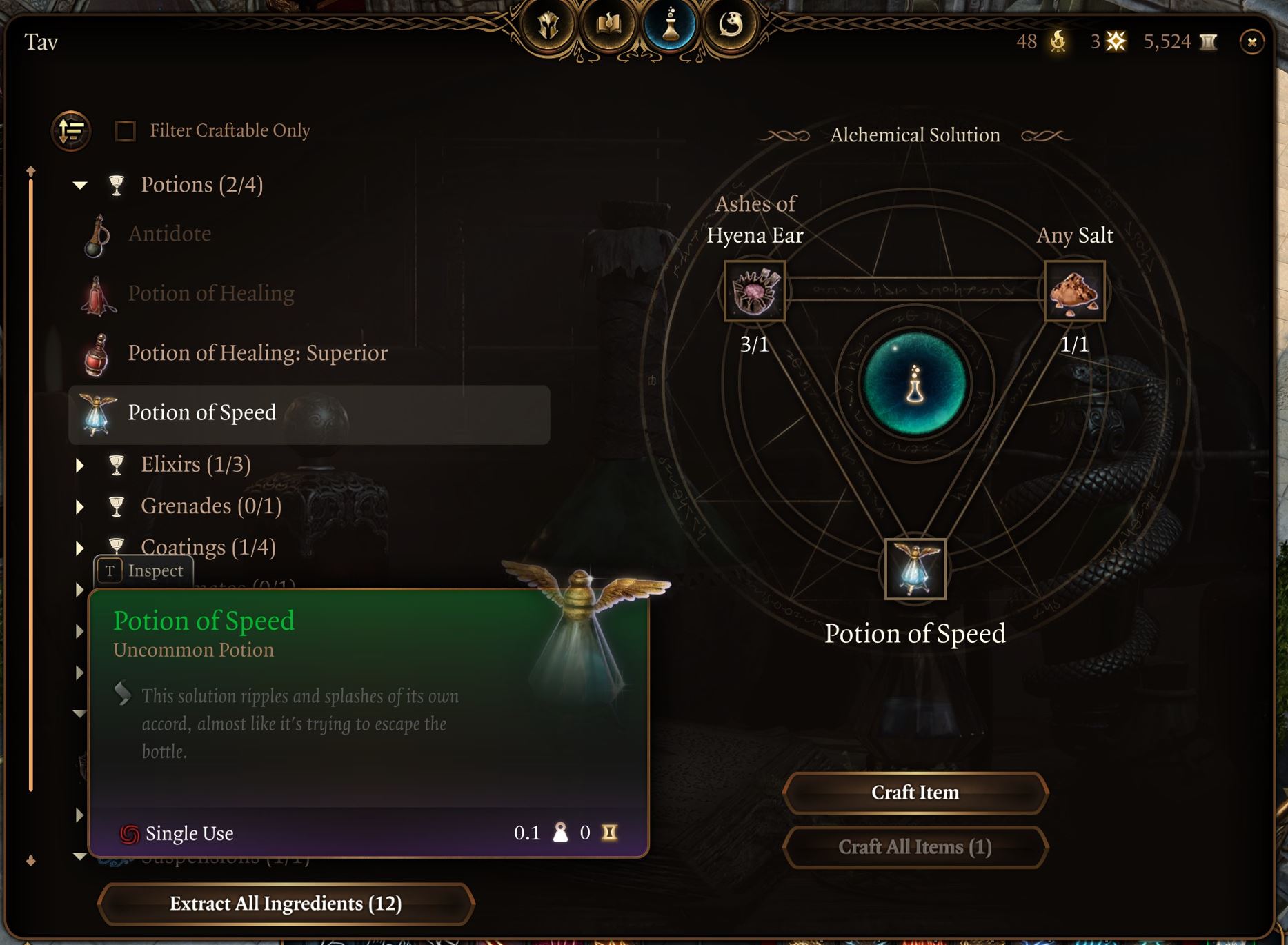
The  Potion of Speed is arguably the most powerful potion in Baldur’s Gate 3. It doubles your Movement Speed and gives you an
  extra Action each turn.
One drawback of this potion is that when it expires, your character will be  Lethargic for one turn, unable to move or take any Actions. So you should be careful not to have your character stranded in a dangerous position when the potion runs out!
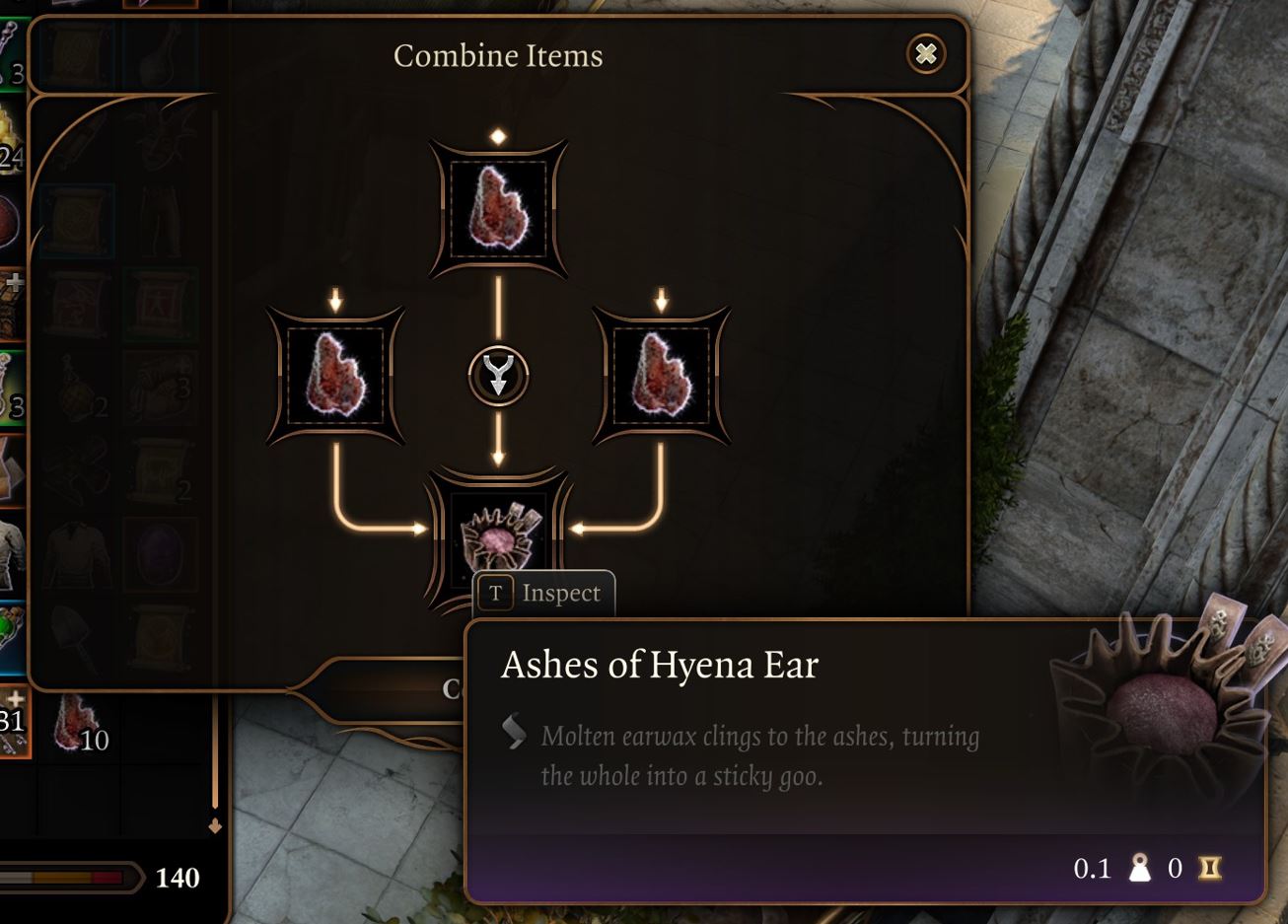
You can craft the Potion of Speed in the alchemy menu by combining  Ashes of Hyena Ear with any Salt. Create ashes, salts and other alchemy concentrates by combining three of the same ingredients together – for example, combining three
  Hyena Ears will create Ashes of Hyena Ear.
Hyena Ears can normally be looted from either Hyenas or Gnolls – you can find a lot of them around the Risen Road in Act I, for a good supply of them, which should last you a while.
You can combine this with the  Elixir of Bloodlust. Elixirs and Potions can be stacked with each other, but you can only have one Elixir active at a time. Potions tend to expire after a few turns, whereas Elixirs last until your next Long Rest, unless you drink a different Elixir in the meantime.
The Elixir of Bloodlust grants your character another Action when you kill an enemy. This effect can only trigger once per turn. Combined with the Potion of Speed, this gives you two additional attacks if you defeat an enemy on your turn.
It can be crafted by combining  Ashes of Worg Fang with any Salt.
  Worg Fangs are looted from Worgs, the beasts usually kept by Goblins.
This is an OP alchemy combo that you can use to turbocharge the Swarmkeeper’s mobility and damage output in tough fights!
Swarmkeeper Ranger Build Illithid Powers (optional)

Illithid Powers are unlocked later in BG3 when you learn more about Mind Flayers and Tadpoles. By eating Jars of Mind Flayer Parasites you gain one point. This is another optional skill tree that you can get access to if you want. Here are some of the best Illithid Powers for the BG3 Ranger Build with the Swarmkeeper subclass:
- Concentrated Blast: Allows you to deal extra damage to a target when you are Concentrating on a spell, potentially also healing if the target is Concentrating too. Ideally you will spend a lot of time Concentrating on either Hex or an AoE like Hunger of Hadar, so you should be able to get good use from this.
- Cull the Weak: When you reduce a creature’s hit points below a certain threshold, this power instantly kills it and deals 1-4 Psychic Damage to nearby enemies. This is particularly effective when engaging groups of weaker foes, enabling you to thin their numbers rapidly.
- Fly: This can be used to reach hard to get to places or change positions in combat. Use this to keep your Warlock safe from enemy attacks, so your Concentration won’t get disrupted as easily.
- Black Hole: This power creates an area-based effect that pulls in and slows targets. It’s particularly useful for crowd control, allowing you to cluster enemies together for area-of-effect attacks or to isolate them from vulnerable allies. Try getting the Haste buff from a Potion of Speed or the Haste spell (lets you perform 2 Actions on one turn), then casting Black Hole and then Hunger of Hadar to cause a world of pain for a group of enemies.
- Psionic Backlash: This is a top-tier reaction from the Illithid Powers skill tree in BG3. This allows you to deal psychic damage when a nearby enemy casts a spell. This is especially useful if the target is casting a Concentration Spell. The damage from Psionic Backlash can immediately break their Concentration, ending the spell’s effects.


Other Baldur’s Gate 3 Builds
- Druid Build – Circle of the Moon
- Bard Build – College of Lore
- Monk Build – Way of Shadow
- Monk Build – Way of the Four Elements
- Monk Build – Way of the Open Hand
- Necromancer Build – Necromancy
- Fighter Build – Battle Master
- Barbarian Build – Berserker
- Warlock Build – Great Old One
- Cleric Build – Light Domain
- Rogue Build – Thief
- Sorcerer Build – Wild Magic
- Wizard Build – Evocation School
- Paladin – Oath of Ancients
- More Baldur’s Gate Guides & Builds